Himi 411 - Error Codes P0261 and P0030

PieMon

Active Member
Good day to you all!
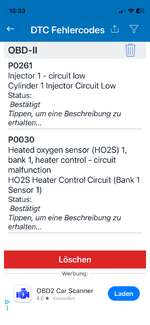
Since of today my Engine Light on my Himi 411/BS6/2022 came and stayed on - connected the OBD2 and the error codes read p0261 (Injector 1 - circuit low) and P0030 (heated oxygen sensor, Circuit Malfunction.
The bike has done 3000km, bought it with 1500km and has no engine or other performance mods yet.
I must admit, that I usually had older, carburator bike, so I am at a bit of a loss - can anyone help?
Also, living in rural Portugal does not offer any options workshop wise.
Thank you
 

Attachments

  • IMG_0437.PNG
    IMG_0437.PNG
    269.1 KB · Views: 26
Last edited by a moderator:
As a general rule: whenever the yellow light comes on and you have a dongle/app that allows for reset - just do it. delete the errors and watch if they re-appear. very often they do not.

In any case AI today is pretty good at telling you want they mean - but be careful with instructions what to do about them, AI also does quite a bit of hallucinations but if you double check the "do-this-then-do-that" part you should be fine.

here is what gemini has to say about your particular case:

P0261: Injector 1 – Circuit Low

This code means the Engine Control Unit (ECU) has detected lower-than-expected voltage at the fuel injector circuit.

  • Symptoms: Hard starting, engine sputtering, loss of power, or a "limp mode" feel.
  • Common Causes:
    1. Loose Connection: The plug on top of the fuel injector may be loose or vibrating off.
    2. Dirty/Corroded Contacts: Moisture or dust in the injector connector.
    3. Low Battery Voltage: If your battery is weak, the ECU may struggle to trigger the injector properly.
    4. Wiring Harness Rubbing: A common Himalayan quirk where wires rub against the frame near the headstock or under the tank.
P0030: Heated Oxygen Sensor (O2) – Circuit Malfunction

This indicates a problem with the heater element inside the O2 sensor (located on the exhaust header). The heater helps the sensor reach operating temperature quickly.

  • Symptoms: Slightly higher fuel consumption, rougher idling during warm-up, and the CEL staying on.
  • Common Causes:
    1. Blown Fuse: Check the fuse box under the seat; a blown fuse can kill the heater circuit.
    2. Damaged Wiring: The O2 sensor wire is exposed to high heat and road debris. Check for melted or frayed wires.
    3. Faulty Sensor: The internal heating element may have simply burnt out.
 
As a general rule: whenever the yellow light comes on and you have a dongle/app that allows for reset - just do it. delete the errors and watch if they re-appear. very often they do not.

In any case AI today is pretty good at telling you want they mean - but be careful with instructions what to do about them, AI also does quite a bit of hallucinations but if you double check the "do-this-then-do-that" part you should be fine.

here is what gemini has to say about your particular case:

P0261: Injector 1 – Circuit Low

This code means the Engine Control Unit (ECU) has detected lower-than-expected voltage at the fuel injector circuit.

  • Symptoms: Hard starting, engine sputtering, loss of power, or a "limp mode" feel.
  • Common Causes:
    1. Loose Connection: The plug on top of the fuel injector may be loose or vibrating off.
    2. Dirty/Corroded Contacts: Moisture or dust in the injector connector.
    3. Low Battery Voltage: If your battery is weak, the ECU may struggle to trigger the injector properly.
    4. Wiring Harness Rubbing: A common Himalayan quirk where wires rub against the frame near the headstock or under the tank.
P0030: Heated Oxygen Sensor (O2) – Circuit Malfunction

This indicates a problem with the heater element inside the O2 sensor (located on the exhaust header). The heater helps the sensor reach operating temperature quickly.

  • Symptoms: Slightly higher fuel consumption, rougher idling during warm-up, and the CEL staying on.
  • Common Causes:
    1. Blown Fuse: Check the fuse box under the seat; a blown fuse can kill the heater circuit.
    2. Damaged Wiring: The O2 sensor wire is exposed to high heat and road debris. Check for melted or frayed wires.
    3. Faulty Sensor: The internal heating element may have simply burnt out.
Thank you.
My engine light is more orange/red - and I reset the errors using the app - but they reappear.

P0030: Heated Oxygen Sensor (O2)
In the meantime I have taken out the sensor and cleaned it with a microfibre rag and a bit of breakcleaner.
I checked the wires of the sensor (seem ok) and checked the plug/connection - seemed ok but took it apart and put in connector spray.
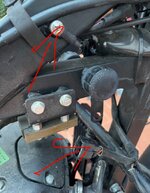
Also checked the mass point on the upper frame above engine.
Bike has only done 3000km, basically new, but will check more for wires rubbing on frame etc.
I checked the fusebox under the seat - all good.
So, not sure how to continue - the sensor might be broken already, is there a way to check it?

P0261: Injector 1
I will check the plug again - not easy to get to and to open.
Will ckeck again for wires rubbing against frame, but seemed fine.
Battery is 3 months old and seemed fine. I am charging it now, was at just under 75% (I put an optimate USB Charger recently, not sure I trust it), but battery tester said battery is good.

Is there a possible cause that could trigger both errors?
 

Attachments

  • IMG_0439.jpg
    IMG_0439.jpg
    304.7 KB · Views: 24
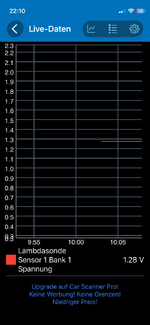
I have the feeling that the Heated oxygen sensor might be defect. As far as I could find in the net, the voltage should be oscilating between 0.1V-0.9V
My OBD says (if I am not mistaken), that mine is 1.28V and not oscilating at all .
Since I have not done this before (never had a bike with OBD, FI, Cat etc.), can any one confirm this maybe?
I measured with ignition on, engine off and using the Car Scanner App.
Since it seems virtually impossible to get a new senor in Portugal and since they are rather pricey anyway, is the sensor delete kit a good option that does not hurt the engine?
Thank you
 

Attachments

  • IMG_0440.PNG
    IMG_0440.PNG
    218.8 KB · Views: 23
@Dool can you chime in here (he knows about O2 sensor and stuff)
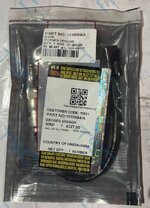
the sensor is absolutely needed - in close loop mode the ecu reads it and manages the engine accordingly. AFAIK the Hima only has a simple narrow band sensor that can basically only switch between 2 values - too rich or too lean. They are inexpensive. Price here is 40 euros.
 

Attachments

  • 1010084_78f03324-2814-4a6d-9ccd-f86e7cd73c14.jpg
    1010084_78f03324-2814-4a6d-9ccd-f86e7cd73c14.jpg
    118.7 KB · Views: 20
Here is Gemini's input regarding your problem:

Checking an O2 sensor on the Himalayan 411 is straightforward because it is a standard automotive-style component. If your OBD2 scanner is throwing a code like P0130 (Circuit Malfunction) or P0131 (Low Voltage), you can verify the sensor's health using a multimeter.

1. The Visual Inspection (The "Free" Test)​

Before breaking out the tools, unplug the sensor and look at the tip:

  • Sooty Black: Indicates an overly rich mixture (the sensor might be fine, but the engine is struggling).
  • White/Gritty: Indicates silica contamination (usually from using the wrong gasket sealer or additives).
  • Oil-fouled: If your bike is burning oil, the sensor will eventually "blind" itself.

2. Testing the Heater Circuit (Resistance)​

Most O2 sensor failures on the Himalayan aren't the sensor's ability to read gas, but the internal heater burning out.

  1. Set your multimeter to Ohms ($\Omega$).
  2. On the sensor plug, identify the two wires of the same color (usually white). These are the heater wires.
  3. Touch the probes to these two pins.
  4. Result: You should see a low resistance (typically 8 to 15 Ohms). If the multimeter reads "OL" (Open Loop) or infinite resistance, the heater is dead and you need a new sensor.

3. Testing the Signal (Voltage)​

This tests if the sensor can actually "see" the oxygen levels.

  1. Reconnect the sensor and start the bike. Let it warm up for 5 minutes (narrowband sensors don't work when cold).
  2. Set your multimeter to DC Millivolts (mV).
  3. Back-probe the signal wire (usually black) and the ground wire (usually grey).
  4. Result: With the engine running, the voltage should "cross" back and forth between 0.1V (100mV) and 0.9V (900mV) rapidly.
    • If the voltage stays stuck at a steady 0.45V, the sensor is likely "lazy" or dead.
    • If you snap the throttle open, you should see an instant jump toward 0.9V (rich).

4. The "Lighter Test" (Off-Bike)​

If you have the sensor off the bike, you can do a bench test:

  1. Connect your multimeter to the signal wires (Black and Grey).
  2. Use a propane torch or a high-quality lighter to heat the sensor tip until it’s hot.
  3. Result: As the flame consumes the oxygen around the tip, the voltage should climb toward 0.9V. When you remove the flame, it should drop almost instantly to 0.1V. If it responds slowly, the sensor is defective.

A Common Himalayan "Fake" Error​

Sometimes the Himalayan throws an O2 error not because the sensor is bad, but because there is an exhaust leak at the header flange (where the pipe meets the engine). Fresh air sucks into the exhaust, hits the sensor, and the ECU panics because it thinks the bike is running lean. Check those two header nuts for tightness before buying a new sensor!

 
@Dool can you chime in here (he knows about O2 sensor and stuff)
the sensor is absolutely needed - in close loop mode the ecu reads it and manages the engine accordingly. AFAIK the Hima only has a simple narrow band sensor that can basically only switch between 2 values - too rich or too lean. They are inexpensive. Price here is 40 euros.
Yes, but in Portugal you can not buy it - in Germany/UK etc its more than 100€ (more like 150€ with postage etc.) and does not arrive over night. So I am trying to make sure I understand the problem first. Have not found that sensor on another bike or car either.
 
Here is Gemini's input regarding your problem:

Checking an O2 sensor on the Himalayan 411 is straightforward because it is a standard automotive-style component. If your OBD2 scanner is throwing a code like P0130 (Circuit Malfunction) or P0131 (Low Voltage), you can verify the sensor's health using a multimeter.

1. The Visual Inspection (The "Free" Test)​

Before breaking out the tools, unplug the sensor and look at the tip:

  • Sooty Black: Indicates an overly rich mixture (the sensor might be fine, but the engine is struggling).
  • White/Gritty: Indicates silica contamination (usually from using the wrong gasket sealer or additives).
  • Oil-fouled: If your bike is burning oil, the sensor will eventually "blind" itself.

2. Testing the Heater Circuit (Resistance)​

Most O2 sensor failures on the Himalayan aren't the sensor's ability to read gas, but the internal heater burning out.

  1. Set your multimeter to Ohms ($\Omega$).
  2. On the sensor plug, identify the two wires of the same color (usually white). These are the heater wires.
  3. Touch the probes to these two pins.
  4. Result: You should see a low resistance (typically 8 to 15 Ohms). If the multimeter reads "OL" (Open Loop) or infinite resistance, the heater is dead and you need a new sensor.

3. Testing the Signal (Voltage)​

This tests if the sensor can actually "see" the oxygen levels.

  1. Reconnect the sensor and start the bike. Let it warm up for 5 minutes (narrowband sensors don't work when cold).
  2. Set your multimeter to DC Millivolts (mV).
  3. Back-probe the signal wire (usually black) and the ground wire (usually grey).
  4. Result: With the engine running, the voltage should "cross" back and forth between 0.1V (100mV) and 0.9V (900mV)rapidly.
    • If the voltage stays stuck at a steady 0.45V, the sensor is likely "lazy" or dead.
    • If you snap the throttle open, you should see an instant jump toward 0.9V (rich).

4. The "Lighter Test" (Off-Bike)​

If you have the sensor off the bike, you can do a bench test:

  1. Connect your multimeter to the signal wires (Black and Grey).
  2. Use a propane torch or a high-quality lighter to heat the sensor tip until it’s hot.
  3. Result: As the flame consumes the oxygen around the tip, the voltage should climb toward 0.9V. When you remove the flame, it should drop almost instantly to 0.1V. If it responds slowly, the sensor is defective.

A Common Himalayan "Fake" Error​

Sometimes the Himalayan throws an O2 error not because the sensor is bad, but because there is an exhaust leak at the header flange (where the pipe meets the engine). Fresh air sucks into the exhaust, hits the sensor, and the ECU panics because it thinks the bike is running lean. Check those two header nuts for tightness before buying a new sensor!
Thank you very much for your input, really appreciate it. I will elaborate a bit on what and how I tested, since my previous bikes never had FI, O2 sensors etc. and therefore I am at a bit of a loss. Also want to rule out my testing is wrong ;-)

1. Visual inspection
- was fine, light brown. Cleaned it anyway with a bit of break cleaner and a cloth

2. Resistance
- I saw that in a video last night and got a reading of 15 Ohm (Sensor removed from bike when measuring)

3. Testing the signal
- I removed the sensor, switched on ignition and got a reading of 12.5V at the Orange and the Blue/Grey wire. So the voltage gets to the connection at least.
- I dont understand how to ' Back-probe the signal wire (usually black) and the ground wire (usually grey), especially when bike is switched on?

- I did put the tank back on, reconnected all connectors (took them all apart to check for dirt or loose connections), run the bike and check with the OBD dongle and Car scanner app.

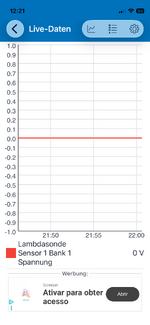
I connected the OBD and during start up there was a spike, but when the bike was running, it was a flat line at 0 (Photo)
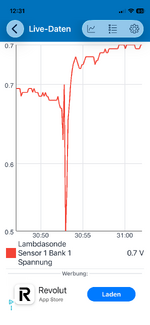
When I restarted the bike the OBD wasshowing voltage, but nowhere near 0.1-0.9, more staying around 0.6V (Photo)
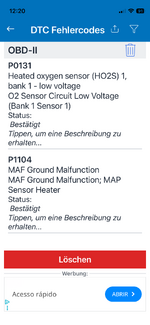
Also got a new P1104 Error, which seems related to Sensor heater (Photo)

Is it still necessary to do the above Back-probing ?

4. Lighter Test - will leave that to the last, would need to organize some clamps for my (very basic) Voltmeter.

5. Fake error - good point, have just checked it, all good
 

Attachments

  • IMG_0444.PNG
    IMG_0444.PNG
    225.3 KB · Views: 21
  • IMG_0442.PNG
    IMG_0442.PNG
    250.2 KB · Views: 19
  • IMG_0441.PNG
    IMG_0441.PNG
    252.8 KB · Views: 20
Last edited:
I have not had a failure of the engine O2 sensor, I did have a wide band sensor failure on my AFR Meter .
My understanding is that the loss of the sensor will force the ECU to rely solely on its mapping which may or not be an improvement, the sensor is disconnected for some dyno tuning.
 
Back
Top